Money mechanicsMECH · 03
Issuer, acquirer, network, processor: the cast behind every card payment
A card payment looks like two parties, you and a shop. Behind the button there are at least four more, each with its own job, its own fee and its own say in whether the payment goes through. Here is who they are and what each one does.
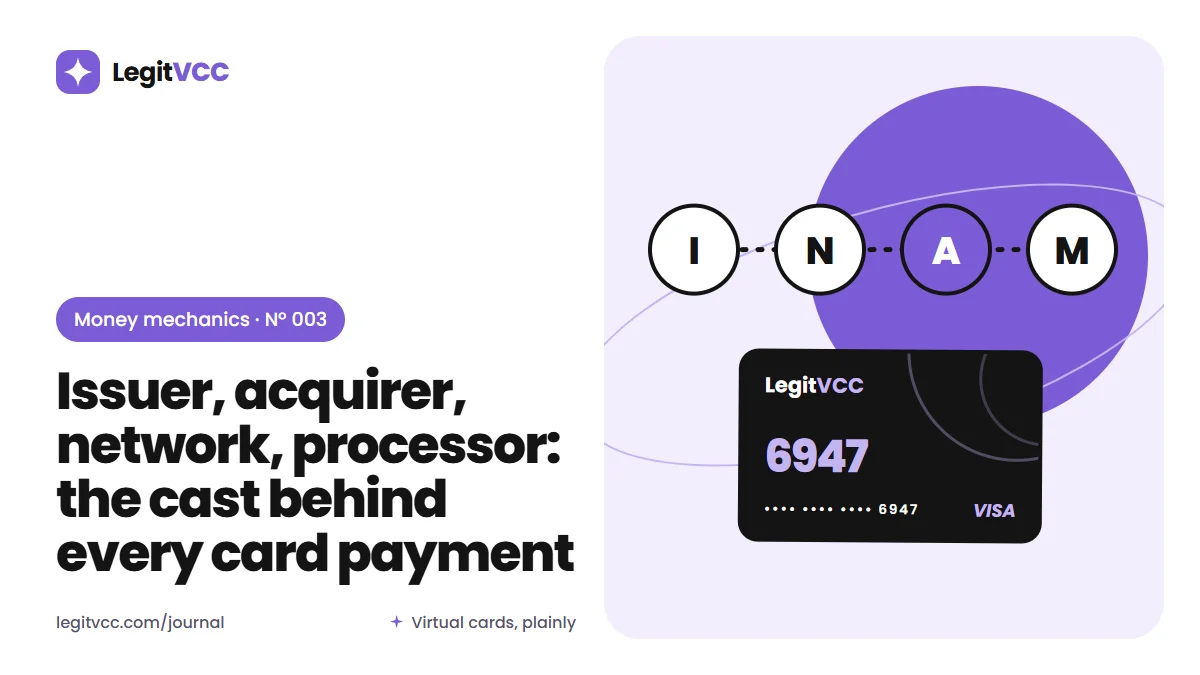
From where you sit, a card payment is a short exchange. You type a number or tap a phone, the shop says thank you, and the money is gone. Two parties, one moment.
The reality is a relay. You press one button; at least four companies you never chose take part in what happens next. Each has a specific job, each charges for it in some way, and each can stop the payment. Knowing who they are explains a surprising number of everyday puzzles: why a payment was declined when you had money, why a refund takes days, why the name on your statement looks strange.
The two people you can see
Start with the obvious pair.
- The cardholder is you, the person paying.
- The merchant is the business being paid, whether a corner shop or a global marketplace.
Everything else in this piece happens between those two, usually in a few seconds and almost always out of sight.
The issuer: your side of the table
The issuer is the institution that gave you the card. For a credit card it is the lender; for a debit card, your bank; for a virtual card like ours, the institution behind the card program, often working with a company that runs it day to day.
The issuer's main jobs:
- deciding whether to approve each payment, based on your balance or credit limit and its own risk checks;
- moving money out of your account when the payment settles;
- handling your disputes and chargebacks.
When a payment is declined, the decision almost always comes from the issuer.
The acquirer: the shop's side
The acquirer, sometimes called the merchant bank, is the institution that lets a business accept card payments. It signs the merchant up, receives the money from card payments and pays it into the merchant's account, minus fees.
The acquirer also carries risk. If a merchant takes payments and disappears before delivering, the acquirer may end up repaying customers through chargebacks. That is why acquirers vet merchants and watch their activity.
The network: the rules and the road
The card network is the brand printed on the card. It connects issuers and acquirers worldwide, carries the messages between them and sets the rules everyone must follow: how authorizations work, how disputes are resolved, what data must be protected and which fees apply.
In some systems, the network and the issuer are the same company. More often, the network licenses its brand to many banks, which issue the cards themselves.
The processor and the gateway
Between the merchant and the acquirer there are usually technology companies.
- A payment gateway captures the card details at checkout and sends them securely onward.
- A processor handles the technical traffic, routing authorization requests and settlement files.
Some companies do both jobs, and some acquirers do them too. For a small shop, these roles are often bundled into one payment provider that signs it up, takes the payments and pays it out, sitting on top of an acquirer.
The first trip: authorization
When you pay, a request travels from the merchant through the gateway and processor to the acquirer, across the network to the issuer, and back. The issuer checks the card, the available funds and its risk signals, then replies approve or decline. The round trip usually takes a second or two.
An approval at this stage is a promise, not a transfer. The issuer reserves the amount, which is why you may see a pending charge.
The second trip: clearing and settlement
Later, often at the end of the day, the merchant sends the approved transactions for clearing. The network calculates who owes what to whom, and settlement moves the money: from issuers, through the network's arrangements, to acquirers, and finally to merchants.
That delay explains why a pending charge can look different from the final one, and why a refund takes time. The principle is simple: settlement runs on schedules, not on button presses.
Who gets paid, and how
Each role earns something from the payment, usually as a share of a fee the merchant pays. The issuer receives a portion, the network charges its own fees, and the acquirer and processor add their margins. The merchant's total cost is often bundled into a single percentage plus a small fixed amount.
You rarely see any of this directly. It shows up in prices, in minimum spend rules and sometimes as a surcharge. We look at how added costs surface on the last screen in drip pricing.
Where disputes travel
If something goes wrong, you complain to your issuer. The issuer may raise a chargeback through the network to the acquirer, which passes it to the merchant. The merchant can respond with evidence. The network's rules decide the outcome.
This is the relay running backwards, and it is why disputes take weeks rather than days: each party has a set time to respond.
Where a virtual card fits
A virtual card like ours runs on the same cast. The difference is the money behind it: instead of drawing on a bank account or a credit line, it holds the balance put on it when it was ordered. Merchants see an ordinary card payment; the issuer checks that balance rather than a credit limit.
On our side, the process page shows each step from your order to a card you can use, including the person who checks your payment before anything is issued. The fees page lists what that costs, as two figures you see before paying.
Questions people ask
Why was my payment declined when I had enough money?
The issuer may have flagged it as unusual, the merchant's acquirer may have rejected it, or the merchant may not accept that card type. The decline message usually comes from the issuer.
Why does a refund take longer than a payment?
The payment's authorization is instant, but money moves through clearing and settlement on fixed schedules. A refund travels the same road, in reverse.
Is the network the same as my bank?
Usually not. The network is the brand and the rails; your bank is the issuer that uses them.
- card payments
- issuers
- acquirers
- payment networks