Money mechanicsMECH · 03
Interchange: the fee inside every card payment that you never see
Every time you pay by card, a fee moves from the shop's bank to yours. You never see it, the shop rarely names it, and it shapes prices, rewards programs and surcharges all the same. Here is what interchange is, who sets it and why it matters.
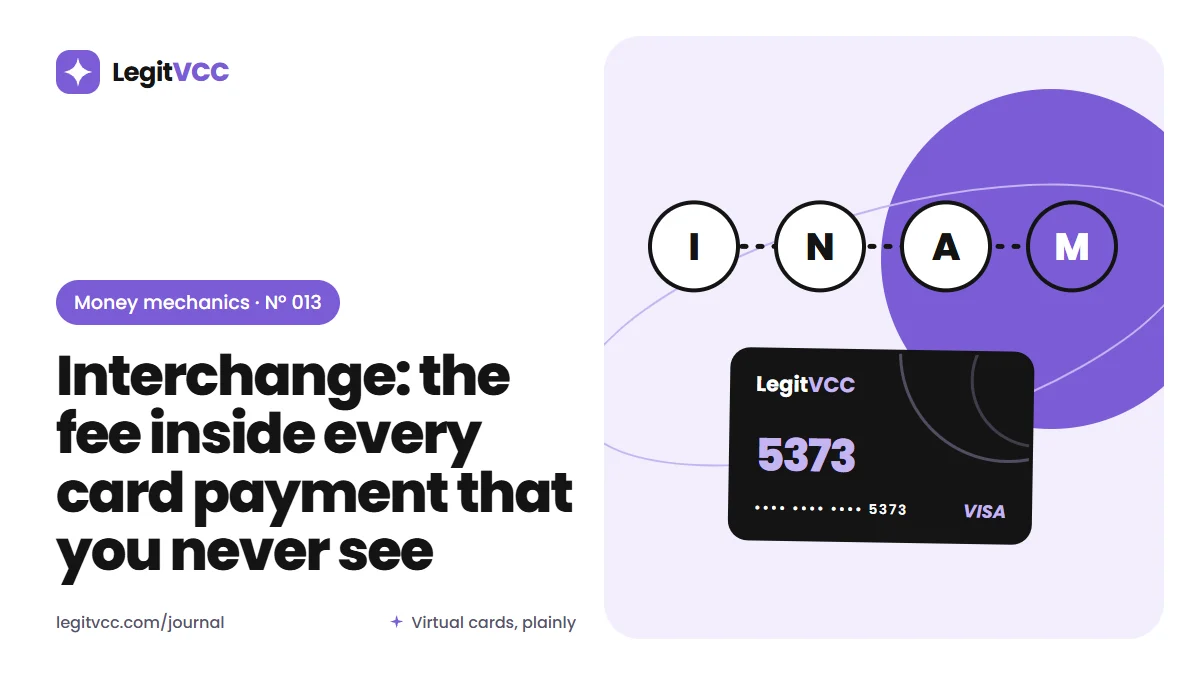
When you pay a shop $50 by card, the shop does not receive $50. A small slice goes to the companies that made the payment possible, and the largest part of that slice usually goes to the bank that issued your card. That part has a name: interchange.
You never see it on a receipt. The shop rarely mentions it. Interchange is the price of a card payment that neither the buyer nor the seller negotiates. It quietly shapes prices, rewards programs and the rules some shops put on card use.
A quick reminder of who is involved
A card payment involves the cardholder and merchant you can see, plus an issuer (your card's bank), an acquirer (the shop's bank), a card network and usually a processor. We introduced them in the cast behind every card payment.
Interchange flows between two of them: from the acquirer to the issuer, on every purchase.
What interchange pays for
The official rationale is that the issuer bears costs and risks the shop benefits from: it guarantees the payment, absorbs some fraud, runs the customer service for the card and, for credit cards, lends the money until the bill is paid. Interchange compensates the issuer for that.
Whether the level is fair is a long-running argument between merchants, banks, networks and regulators. What is not in dispute is that it is a cost of accepting cards, and that the merchant ultimately pays it.
Who sets the rates
Interchange rates are generally set by the card networks, not by the banks that receive them or the shops that pay them. Networks publish rate schedules, often very long ones, with different rates for different situations. In some places, laws cap the rates; in others, the networks set them within whatever rules apply.
That arrangement is the origin of the "nobody negotiates it" problem. The shop cannot bargain with your bank, and you have no idea what rate your card carries.
Why rates differ
The same $50 purchase can carry different interchange depending on:
- the card type: debit or credit, standard or premium;
- how it was paid: in person with a chip, or online;
- the merchant category: some categories have special rates;
- the region: domestic and cross-border payments are often priced differently;
- the size of the issuer, in places where rules treat large banks differently.
Online payments and premium rewards cards tend to carry higher rates. That is one reason a merchant may prefer one card over another without ever saying so.
Where the law steps in
Some governments regulate interchange directly. In the European Union, rules adopted in 2015 capped interchange on most consumer card payments at small fractions of a percent. In the United States, a 2010 law capped interchange on debit cards issued by large banks, while credit card rates were left to the networks. Other countries have their own approaches.
These rules are detailed and change over time, so treat the summary as orientation rather than a statement of current rates where you live.
Interchange and your rewards
Card rewards, from cash back to air miles, are funded largely by interchange. A premium card with generous rewards usually carries a higher rate, paid by the merchant, which the merchant spreads across its prices.
The uncomfortable consequence is that a customer paying cash or with a basic debit card can, in effect, help pay for someone else's rewards. That is one of the arguments made for regulation, and one reason rewards tend to be smaller where interchange is capped.
From interchange to the merchant's bill
The merchant does not usually see interchange as a separate line. It pays a total cost that bundles:
- interchange, which goes to the issuer;
- network fees, which go to the card network;
- the acquirer's or payment provider's margin.
Some providers charge "interchange plus" pricing, passing interchange through and adding a fixed margin. Others charge a single blended rate. Either way, interchange is often the largest component.
Why some shops add surcharges or minimums
When card costs are high relative to a sale, merchants respond. Some set a minimum card spend. Some add a surcharge for card payments, where rules allow it. Some offer a small cash discount instead. Each of these is a way of passing on a cost that is otherwise hidden.
Surcharge rules vary by country and by network, and in some places surcharging is restricted or banned. If you see one, the honest version tells you before you pay and names the amount. The dishonest version appears late, a pattern we covered in what an honest fee page looks like.
What this means for virtual cards
Virtual cards travel on the same rails, so merchants pay interchange on them too. The card's issuer receives it, and it is one of the ways a card program funds itself alongside any fees charged to the cardholder.
For you as a cardholder, interchange is invisible either way. What you can see are the fees charged to you directly. On our fees page, those are two figures: a flat amount per card and a percentage of the amount you load. Both are on screen, with the total, before you pay.
Reading prices with interchange in mind
You do not need to calculate interchange to shop well. A few habits are enough:
- notice card surcharges and compare them with other payment options;
- remember that rewards are paid for somewhere, often in prices;
- expect online prices to absorb a slightly higher payment cost;
- prefer sellers who name their charges before checkout.
Questions people ask
Can I find out the interchange rate on my card?
Not easily. Networks publish schedules in some regions, but working out the rate for a specific purchase requires details only the payment companies have.
Does interchange make prices higher?
Card acceptance costs are part of a merchant's overheads, like rent, and are reflected in prices to some degree. How much depends on competition and local rules.
Is a card surcharge legal?
It depends on the country and the network's rules. Where allowed, it usually must be disclosed before payment and kept within limits.
- interchange
- card fees
- merchants
- payment costs